


The second session of IMAA’s Applied Artificial Intelligence (AI) in M&A Webinar Series moved from theory into practice. It zoomed in on one of the most time-intensive early phases of any deal: origination and sourcing.
The first session established a conceptual map of AI across the deal lifecycle. This session tackled a harder question. What does AI actually do when you need to identify the right target, at the right time, before anyone else does?
James McVeigh is the founder and CEO of both CDX Advisors LLC and Cyndx Networks LLC. Cyndx is a leading search and discovery platform that leverages AI to organize global corporate information, powering M&A activity, fundraising, and general business growth. Kal Kilpi is a two-time M&A software founder and hands-on engineer. Today at CorpDev.Ai, he is building an AI‑native, end‑to‑end M&A platform. The session was moderated by Prof. Dr. Christopher Kummer, Founder and CEO of IMAA.

The Core Problem: Finding Deals Before They Happen
In M&A, being early is everything. An acquisition idea brought to a client after the deal is announced is a missed opportunity. The value of deal origination lies in uncovering the right opportunities before they become visible to the broader market. This includes identifying strategic acquisitions, distressed assets, and emerging platform investments ahead of the competition.
That is precisely where AI is changing the game, but not through the blunt instrument of a general-purpose chatbot.
McVeigh described the challenge his team set out to solve at Cyndx: “How do you use technology and AI, machine learning back then, to identify opportunities and counterparts, whether you’re raising capital or doing M&A?”
That mission required something far more ambitious than querying public data. It required mapping the world.
Today, Cyndx makes over 33 million companies available to users, with an additional 25 million profiles in development, translated across more than 100 languages. The scale is deliberate.
A small bolt-on acquisition target in Spain may not have an English-language website. If your data set only covers what is easily accessible in English, you are missing a significant portion of the actual deal universe.
Prediction, Not Just Discovery
The distinction between finding companies and predicting which ones will be involved in transactions is where AI earns its place in the sourcing process.
Cyndx’s “Projected to Raise” algorithm identifies companies that are likely to need capital. It does so before those companies have publicly indicated any such intent. Across all sectors, this prediction is accurateapproximately 86% of the time.
In data-rich sectors like technology and healthcare, accuracy approaches 100%.
“For an M&A professional, whether you’re a banker, corporate development, or a private equity person, you want to be in front of it. It’s great to read about it, but it’s better to be able to influence or be a part of that transaction,” McVeigh said.
The platform’s Acquire tool takes the same principle and applies it to strategic buyers. Rather than asking who might buy a given company, it asks: given what this company is doing, what would they logically acquire next?
Cyndx predicted that Expedia would acquire a specific business in Ireland, and it did.
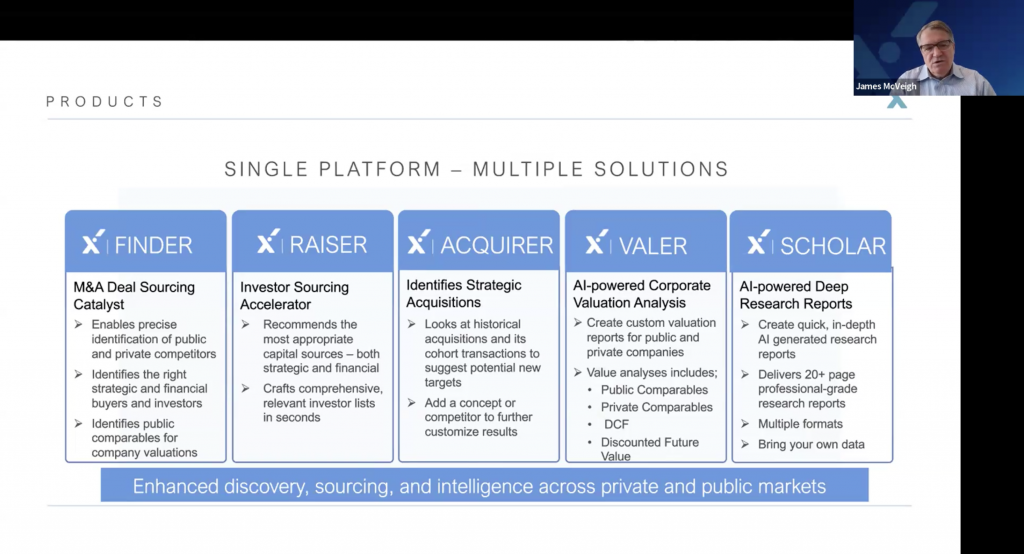
This is not pattern matching against public announcements. It is the application of machine learning models trained on years of proprietary behavioral and intent data to surface decisions before they are made.
The Data Problem Is the AI Problem
Both speakers were emphatic on one point: the quality of AI output is entirely determined by the quality of the underlying data. This is not a caveat, it is the central challenge of building AI for M&A.
“All of that information has to be as accurate as humanly possible, or AI possible today, to ensure that the results you’re getting are things that you can actually use. The last thing in the world you want to be as an M&A professional is sitting in a meeting presenting something that’s inaccurate,” McVeigh said.
He shared an instructive example: a large media company using a major general AI tool was told by the system that it had sold one of its divisions. It had not. The division in question was valued at approximately $5 billion.
This is the kind of error that does not just embarrass an M&A professional. In a deal context, it destroys credibility entirely.
For Cyndx, managing this risk means scraping up to 50 million URLs per night, continuously cleaning, vectoring, and curating data so that every output is defensible. Private companies are the hardest case: unlike public companies, they have no obligation to disclose, and their data is scattered, incomplete, and often in languages other than English.
“Large language models are basically trained on publicly available data. The key is getting behind the scenes and getting access to the private data, that’s what will really distinguish you,” McVeigh said.
Large language models trained on publicly available data cannot solve this. The private market is where most M&A actually happens, and it is precisely where generic AI tools are weakest.
From Point Solutions to End-to-End Intelligence
CorpDev.Ai approaches the sourcing problem from a different angle. Rather than building depth in a single vertical, CorpDev.Ai aims to provide an AI-native platform that covers the entire M&A workflow.
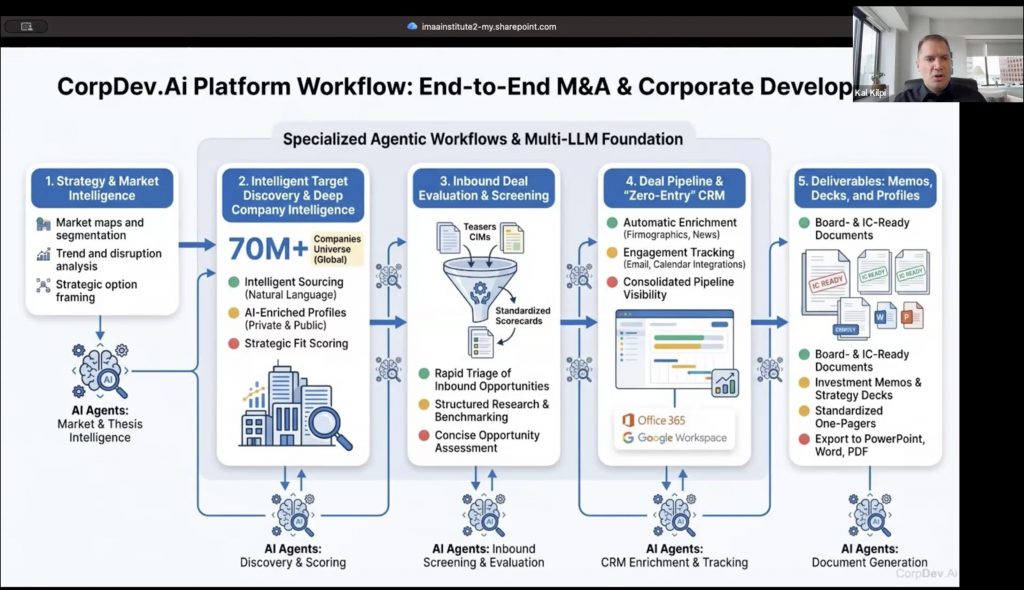
This spans everything from market research and strategy all the way through due diligence, PMI planning, and program learning.
“The time of point solutions is over. You need to have a pretty holistic understanding to do any narrow slice well,” Kilpi said.
Understanding what to source requires understanding market context, competitive dynamics, and strategic intent. Stripping out that context to build a faster sourcing tool produces a faster, but shallower, result.
In his live demonstration, Kilpi walked through what this looks like in practice. Kilpi started with a deliberately complex prompt: develop a plan for Walmart to compete against Amazon in online sales and drone delivery.
From there, the CorpDev.Ai analyst agent took over — conducting structured research, mapping buying situations, and building capability frameworks. It then derived M&A themes and surfaced specific acquisition targets, complete with business cases and prioritization rationale.
The analysis identified drone delivery as the highest-priority theme. The top target recommendation was a company that Walmart had previously partnered with and then parted ways with over unit economicsconcerns.
Since that split, the company had acquired valuable FAA licenses but struggled to replace Walmart as its anchor customer. That combination — regulatory assets plus a weakened commercial position — made it potentially available at a reasonable valuation, with a credible path to improving unit economics under Walmart’s ownership.
Every finding in the analysis was sourced and linked to the underlying documents, allowing a practitioner to verify and interrogate each claim directly.
The Velocity Shift
One of the most practically significant themes to emerge from the session was not about the quality of individual analyses, but about the speed at which teams can now iterate.
“You don’t just get the same thing done faster or easier, you produce many analyses a day. It accelerates your thinking iterations and how you get smarter about different markets and opportunities,” Kilpi said.
This has a compounding effect on M&A thinking. When it takes a week to produce a company profile, a team will commission perhaps a handful per month. When it takes minutes, a team can analyze dozens of opportunities in the time it previously took to assess one.
The result is deeper conviction, a wider aperture, and a sharper eventual thesis.
Kilpi also noted that this is changing what belongs in the “sourcing” phase at all: “What is in the scope of sourcing is changing, because you can do much deeper analysis on prospects before committing any real resources.”
Why Generic LLMs Are Not Enough
A pointed question from the audience asked whether M&A professionals could simply use ChatGPT or a similar general tool instead. Both speakers acknowledged the appeal of that instinct, and both explained its limits clearly.
“If you ask for what companies we should buy, technically the LLM is giving you an answer that kind of looks good — so those names kind of go well with the question,” Kilpi said. “And it’s incredibly good in many cases, but that is still the fundamental technology.”
The structural limitation is that general LLMs are not designed for exhaustive enumeration. They are optimized for fluent, contextually appropriate responses. In practice, that means they tend to surface the obvious names and miss the long tail.
“LLMs are not designed to give you exhaustive lists. They are better at naming a few companies, and often the obvious ones. If you want to go beyond that, you need a slightly different approach,” Kilpi said.
McVeigh put a number to this: Cyndx’s Acquire tool returns up to 100 potential acquisition targets. A general LLM will return 5 to 10. For M&A professionals who need comprehensive buyer lists and tension in a sale process, that gap is not marginal.
It is the difference between a credible process and a narrow one.
What This Means for M&A Teams
A running thread through the audience Q&A was the question of what AI means for the people doing this work, particularly junior analysts and associates.
Neither speaker predicted straightforward job elimination. Both were honest that the nature of the work is shifting, and that teams who fail to adapt will find themselves at a disadvantage.
“The irony of the M&A process is you typically had the most junior person who had the least knowledge bringing you ideas to bring to your client. Now, you empower lower-level analysts and associates to bring more actionable things that give a broader perspective,” McVeigh said.
Kilpi framed the organizational change in terms of role evolution: “Analysts will have to become AI specialists and AI facilitators. The nature of the work will change to be on a more meta level — not doing the work, but thinking how the work should be done, and then the AI kind of does the work for you,” Kilpi said.
Kummer also weighed in on where the human remains indispensable: “When it comes to M&A, these tools will never replace the need to have a one-on-one conversation with senior executives to make a decision on which route to go. What we do is inform you better as to what you should be presenting and what all the risks are.”
Key Takeaways
1) Prediction outspaces discovery.
The real value of AI in sourcing is not finding companies that already exist in databases. It is predicting which companies will be involved in transactions before those transactions are announced. This requires proprietary models trained on behavioral and intent data, not just keyword matching.
2) Private market data is the real moat.
General AI tools are trained on public data. The middle market is where most M&A actually happens. It demands proprietary, continuously updated private-company data. Building and maintaining that data is the hardest and most defensible part of any AI sourcing platform.
3) Velocity changes the scope of sourcing.
When a full company analysis takes minutes instead of days, teams can do far more of it before committing real resources. The boundary between sourcing and early-stage screening is dissolving.
4) Comprehensive coverage requires purpose-built systems.
A general LLM will give you 5–10 acquisition ideas. A purpose-built platform will give you 100. In competitive sale processes, the difference between comprehensive and partial coverage is material.
5) Human judgment remains essential — but at a higher level.
AI handles the information gathering and preliminary analysis. The decisions remain human — which ideas to pursue, how to position a company, how to build a relationship with a counterparty. What changes is the quality and completeness of the information that human judgment is applied to.
The Applied AI in M&A Webinar Series continues with upcoming sessions covering due diligence, AI-driven valuation, and integration planning. Future sessions will also feature contributions from Professor Aswath Damodaran on investing in the age of AI.



Stay up to date with M&A news!
Subscribe to our newsletter