

Last April 16, the Institute for Mergers, Acquisitions and Alliances (IMAA) hosted a webinar exploring how dealmakers are navigating increasing volatility, geopolitical tensions, regulatory shifts, valuation gaps, and financing constraints in today’s M&A environment.

The discussion unpacked how market participants are adapting strategies, reassessing risk and identifying opportunities amid uncertainty.
A Familiar Pattern in M&A during Uncertain Times
While current conditions may feel particularly challenging, volatility is not new. Instead, today’s environment reflects a continuation of long-term cycles shaped by macroeconomic shifts, geopolitical dynamics and technological disruption.
“Uncertainty is not uncommon, but the level of volatility itself has grown. The pace of technological change has accelerated, and we may simply have to get used to operating in more consistently choppy waters,” David Olsson said.
Dealmakers are encouraged to remain agile rather than overcorrecting with rigid, long-term strategies. They should avoid “permanent solutions to temporary problems” and instead adapt to evolving conditions with flexibility and discipline.
Headwinds Persist, but Tailwinds Are Rebalancing Deal Activity
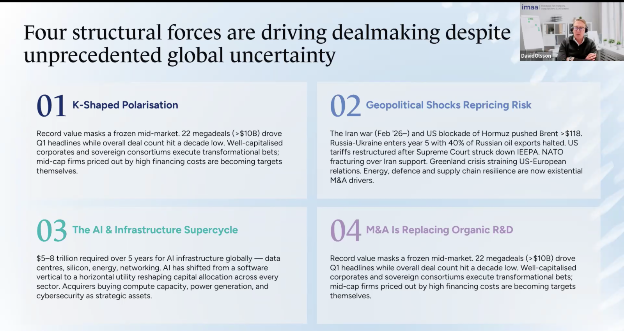
The discussion highlighted a clear tension between macroeconomic headwinds and emerging tailwinds.
Key headwinds include:
- Geopolitical conflict and political instability
- Regulatory complexity across regions
- Heightened risk aversion in certain markets
At the same time, several tailwinds are supporting deal activity:
- Increased predictability in interest rates
- Rapid advancements in AI and technology
- Innovation in financing structures
- Select deregulation trends in markets such as the U.S. and Japan
One of the central questions addressed was whether companies should stick to long-term strategies or pivot in response to market conditions.
According to Joyce, uncertainty often signals opportunity. “There is a very quick and fast fall in activity, but when uncertainty and these types of transitions occur, that also signals opportunity. We’re not seeing buyers leave the market, we’re seeing them become more careful about which deals they pursue,” she said.
While deal activity has slowed, buyers have not exited the market. They have become more selective. At the same time, there is a growing supply of companies entering the market, driven in part by demographic trends and founder exits.
This imbalance is creating a more competitive and scrutinized environment, where preparation and positioning are critical.
A key theme that emerged is the importance of a company’s “moat”, its ability to sustain competitive advantage amid rapid technological change.
“There is going to be more scrutiny around a company’s moat. The larger the moat, the less risk buyers see, especially in volatile times. It’s about proving that your company can withstand continuous shifts in the market,” Mary Joyce said.
AI in M&A: Opportunity with Caution
Artificial Intelligence (AI) is accelerating M&A processes, particularly in market research, buyer identification, and preparation of deal materials. It is reshaping not only business models but also how due diligence is conducted.
While AI tools are improving efficiency in areas such as data processing and analysis, they are also introducing new layers of complexity.
Buyers are now digging deeper, asking questions such as:
- Is the AI built into the product truly unique, or can it be easily copied?
- Does the company rely on proprietary data or publicly available sources?
- How durable is its technological advantage over time?
As a result, AI-focused due diligence frameworks are becoming standard, with increased scrutiny on both technical architecture and long-term defensibility.
However, both speakers emphasized the importance of human oversight.
AI tools, while powerful, are prone to inaccuracies and “hallucinations.” As such, leading firms are implementing:
- Senior-level human review
- Private AI environments to ensure confidentiality
- Clear governance frameworks for AI usage
The consensus: AI should enhance, not replace, human judgment.
Evolving Deal Structures: Creativity in Action
In response to financing constraints and valuation uncertainty, deal structures are becoming increasingly sophisticated.
“We’re seeing much more creativity in deal structuring. Earn-outs are becoming more sophisticated, seller notes are more common, and there’s a shift toward structuring deals in ways that de-risk outcomes for both buyers and sellers,” Joyce said.
Emerging trends include:
- Greater use of earn-outs tied to revenue or retention metrics
- Increased adoption of seller notes to bridge valuation gaps
- More flexible arrangements balancing risk between buyers and sellers
These approaches reflect a broader shift toward shared risk and structured value realization.
Looking Ahead: A More Complex, but Active Market
Despite current challenges, the outlook for M&A remains active:
- Buyers are still deploying capital, albeit more cautiously
- Sellers continue to enter the market in significant numbers
- Market clarity is expected to improve as trends stabilize
Ultimately, success in today’s environment depends on rigor, adaptability, and creativity.
As highlighted during the session, periods of volatility often separate experienced dealmakers from the rest, rewarding those who can navigate complexity with structured thinking and strategic flexibility.
Conclusion
The webinar underscored a key takeaway: volatility is not a barrier to M&A, it is a defining feature of it.
For dealmakers, the challenge is not to wait for stability, but to operate effectively within uncertainty- leveraging new tools, rethinking traditional structures, and continuously reassessing risk and opportunity.
Catch the full webinar replay to see the full case study and learn from the rich Q&A discussion. Available here.




Stay up to date with M&A news!
Subscribe to our newsletter